What is Trapiche Amethyst?
You already know amethyst. That deep, dreaming purple is one of the most loved gemstones in the world for thousands of years. But trapiche amethyst is something else entirely. It is an amethyst that grew differently. Amethyst that carries, locked inside it, a perfectly symmetrical six-pointed star, like a wheel, like a snowflake, like something ancient and intentional pressed into the heart of the crystal.
A trapiche (pronounced tra-PEE-che) is a type of milling wheel historically used to process sugar cane. Its spokes gave trapiche gems their name, for the "arms" of inclusions that radiate outward between the gem's growth sectors. When you look at a trapiche amethyst face-on, that's exactly what you see: a hub, and six spokes spreading outward, as precise as if they were drawn by hand. They weren't. The earth did that.
The Science of the Star
The trapiche effect in amethyst isn't a random occurrence; it's the result of a very specific growth anomaly. As the amethyst crystal forms, it grows in discrete sectors around a central axis, rather than developing uniformly. These sectors create boundaries that trap dark mineral inclusions, often carbon-rich material, which then define the radial spokes.
The black core at the centre is composed of dense metallic dendritic inclusions. The brown colour of the arms is caused by numerous tufts of tiny inclusions, some of which resemble either brushes or bullets under magnification. The pale purple crystal itself fills the spaces between, making the contrast between spoke and stone all the more striking.
This growth pattern requires an ideal set of geological conditions: fluctuating temperatures, complex hydrothermal fluids, and proximity to carbon-rich host rocks. It's a combination of these factors, present only in rare environments, that leads to the formation of trapiche amethyst, a phenomenon that requires just the right set of circumstances to appear.
True trapiches form where geothermal waters meet a carbonaceous host rock. Seed crystals begin to form in those mineral-rich fluids, but instead of growing evenly in all directions, the crystal pauses at its rough edges and continues only along smooth faces, allowing carbonaceous material to settle into the gaps. The result is zoned, sectoral, and breathtaking.
Type A vs Type B
There are two types of trapiche formation, and the difference matters:
Type A (Standard): the gem material grows on the mineral faces, with arms of carbonaceous inclusions forming the spokes. This is the more common of the two types. The star you see is defined by what isn't amethyst; the dark inclusions carve the pattern into the crystal.
Type B (Reverse): exceptionally rare specimens where the gem material itself forms the arms. In a reverse trapiche amethyst, the spokes are the amethyst, and the pattern is inverted. These are extraordinarily uncommon and highly prized by collectors.
It's also worth noting the difference between a true trapiche and a trapiche-like stone: true trapiches have distinct inclusions between separate growth sectors, meaning the crystal is actually broken into individual segments that grow independently. Trapiche-like gems, by contrast, have a continuous crystal with colour zoning or inclusions that create a similar visual effect. Both are rare and beautiful; the distinction matters most to gemologists and serious collectors.
Where Does It Come From?
Trapiche amethyst mining is located in Brazil, in the Amazon region. It is a family business that has been working to introduce this rare amethyst to the world since 2016. Most trapiche amethyst specimens come from small, family-run mines in Brazil, where each piece is cut and polished to highlight the natural symmetry that collectors cherish.
All extraction is done in open-sky mining, which allows a broad view of the richness and diversity of mineral formations present in the same location. At least eight stone types have been found at the same site, with unique and intense zoning and colouration. Trapiche stands out even among these.
The broader story of trapiche gems began not with amethyst, but with emerald: the first trapiche gems were described by mineralogist Émile Bertrand in 1879, who noted a six-ray pattern in emeralds from Colombia. Since then, trapiche formations have been discovered in a handful of gemstones, such as amethyst, sapphire, ruby, and tourmaline, among them. Amethyst is one of the newer additions to this family, and one of the most accessible.
How Rare Is It, Really?
While standard amethyst is abundant and widely distributed, trapiche amethyst is a rarity within its own family. Only a small percentage of amethyst crystals from trapiche-capable environments will form with the required sector-defined growth, and an even smaller fraction will develop spokes with the symmetry and contrast needed to be considered gem-worthy.
Historically, the true trapiche effect has been most strongly associated with emeralds from Colombia, and to a lesser extent, rubies and sapphires. Quartz examples, especially amethyst, are much less frequently encountered in the trade, placing this phenomenon squarely in the realm of niche collectors and those who appreciate the nuances of crystal growth.
In practical terms, you can go into any crystal shop and find regular amethyst. Trapiche amethyst is something you search for, and feel genuinely lucky when you find.
How to Spot a Fake
Because trapiche amethyst commands higher prices, fakes do exist. A true trapiche will have what looks like a starfish in the centre of the stone, and in a trapiche-like stone, the pinwheel pattern is continuous, while in a true trapiche, there are several unconnected pinwheel patterns across the stone.
Many vendors create a fake trapiche pattern using dyes or other methods. These are generally relatively easy to spot; the pinwheel will often look like someone took a black marker and drew directly on top of the stone. You can find these most often as black patterns baked into coloured glass, sold fraudulently on marketplaces like eBay.
When buying trapiche amethyst, always buy from a trusted source who can speak to provenance. A piece with documentation, or from a known Brazilian mine, is always safer than a suspiciously perfect-looking star on a too-cheap stone.
Caring for Trapiche Amethyst
Trapiche amethyst has the same physical properties as regular amethyst, a hardness of 7 on the Mohs scale, making it suitable for jewellery with appropriate care. Keep it away from other jewellery, especially stones like diamond and topaz, that rank higher on the Mohs scale and could scratch it. Clean with a soft cloth and water. Avoid prolonged exposure to direct sunlight, as amethyst can fade over time.
Metaphysical Properties
Amethyst has been prized for its spiritual energy for millennia. Its name comes from the ancient Greek word amethystos, meaning "not drunk", and this violet ray gem has long been associated with protection, clarity, and connection to higher realms.
Amethyst can help you fall into and maintain deeper states of meditation, and its high frequency is said to naturally repel lower energies. It brings a clearer understanding of life experience and helps integrate higher wisdom, associated with balance, peace, purification, and spiritual evolution.
In its trapiche form, these properties are amplified by the geometry of the stone itself. Trapiche amethyst is associated with the crown and third-eye chakras. Crystal healers use it to sharpen mental clarity, enhance spiritual vision, and deepen meditative states. The six-pointed spoke pattern has long been a symbol of sacred geometry, the macrocosm reflected in the microcosm. That the earth grew this shape spontaneously, without any human hand, is part of what makes it feel so significant.
✦ Trapiche amethyst is a stone of layered awareness, the familiar and the rare in one form. It carries amethyst's gift of calm clarity, deepened by the sacred geometry written into its very structure. For those who walk between the seen and unseen, it is a quiet lantern.
A Stone Worth Understanding
Most people who encounter trapiche amethyst for the first time have the same reaction: they don't quite believe it's natural. That star looks too perfect. Those spokes look too even. But that's exactly what makes it extraordinary: the earth, under precisely the right conditions, produced perfect geometry without any intervention.
It is a reminder that nature is never simple. Even a stone as well-known as amethyst still has secrets.
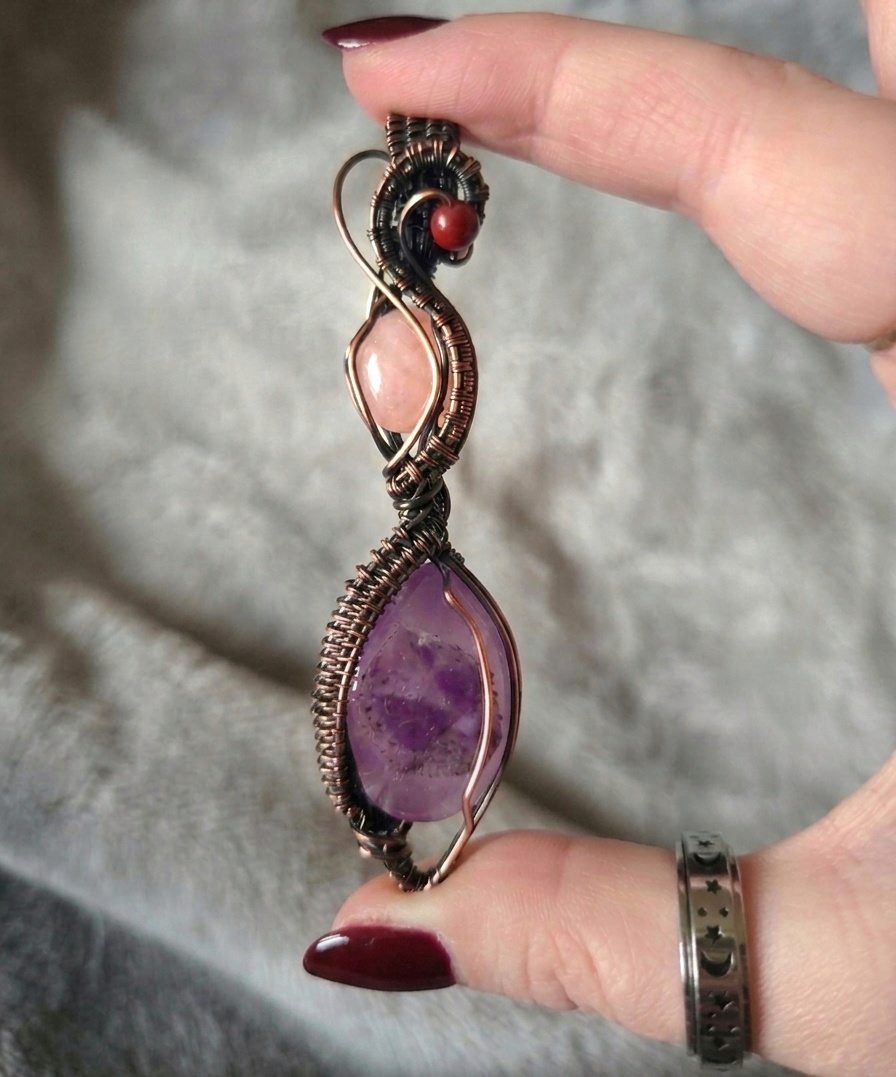
I have one Trapiche Amethyst pendant available, if you're interested in checking it out!
Leave a Reply